Cob and Straw Bale Building in WV: Montani Semper Liberi

Cobing in the hills of WVWild and Wonderful West Virginia

Teresa and I had an amazing time visiting West Virginia this past weekend. We stayed at the Guest House at Lost River with our great friends Bob, David, and Tammy. We had so many wonderful conversations over breakfast and dinner including a chat with Christina who spins and paints her own wool. She gave us some great advise about where to potentially find wool for insulation. We also stopped in to the Lost River General Store a couple of times for lunch, beer, a lavender cookbook, and some more great conversation with Toni and some other folks who were staying at the Inn at Lost River and folks staying at the Guest House.

Cob and Straw Bale Builings

It wasn’t all fun and relaxation for us though! We also visited two natural building projects and even spent about an hour helping to cob in the rain at one of the building sites on Sat.

A Mountain Bale Cob Cottage

Once the rain got too bad and the wind got too cold we needed to quit cobbing. You can see all the photos I took of our cob building adventures here on Facebook. Aside from helping we learned a ton and had even more great conversations. Unlike our plans to use cob for nearly all of the walls (though there is some flexibility there and we might do some straw bale walls) Joelle and Alexor are building with an interesting technique whereby they are using the cob (and empty bottles) as a thick mortar for some of the walls and using the bales almost like bricks between these layers of cob. They’ll have less mass in the walls and more insulation but it should prove to be a great idea considering their building site.

Joelle says they’ve not have a lot of helpers but we’ve talked with several friends from Pittsburgh who are interested in the techniques that they are using and are willing to come play in the mud so come spring time we’ll go back to help and we’ll bring a load of friends too!

Querencia: The Straw Bale Studio

On Sunday on the way back to Pittsburgh we took a detour to Capon Bridge and stopped at Taproot Farm. We met and talked with Beth about a large studio that she is building mostly out of straw bale with a serious amount of cob add-ons and features (such as interior walls, benches, and other great sculptural finishes). The photos of Beth’s studio can be seen here on Facebook.

Straw Bale Studio We didn’t do a lot of physically helping but they had to cancel a living roof workshop planned for Saturday and with the cold and rain Beth said that our visit on Sunday and the photos helped to energize her.

Querencia is already beautiful even without being finished and we’ve made tentative plans to return in the spring to help with the earthen floor.

Cob Is

I had a very vague idea of cob before this trip. I knew I wanted to use it. I knew it was easy to build with, and I knew that it had thermal mass. What I didn’t know was that when we make monolythic cob structures what we are really making is essentially sandstone. The dry cob walls at Joelle and Alexor’s felt like sandstone because that is basically what it is.

I’ve known that the lime plaster, once it hardens, is limestone but I did not understand that the cob is sandstone. We came out of the trees and we found that we could survive in colder places by living in caves. Cob and earthen or “mud” homes should not be thought of as dirt dwellings but as stone dwellings. Mud and dirt or even soil is the organic material that we, and animals, and plans turn into. Clay and sand are the remains of stones, rocks, and mountains.

Just like the materials that we consume which come from the soil help to sustain our lives and are then returned to the earth after we die (or should be) the sand and clay that once was a mountain is again formed into stone when we make cob and when we apply lime plasters. If we allow it to that stone will once again be turned back to sand and clay dust and as the earth spins it will eventually be turned back into compressed rock and maybe even into a mountain again.

Montani Semper Liberi

The motto of the state of West Virginia is Montani Semper Liberi which translates to Mountaineers are Always Free. I was born in the mountain state and have always found this motto comforting. Not because I believe it 100% but because I see examples of how the ability to craft a life seems to be tied to the DNA of West Virginians. It’s probably there in all of us but in West Virginia those genes are switched on. Mountaineers are always free because they can create things and by creating their own lives in the way they feel fits them best these folks are more free than most.

The freedom to build oneself a shelter and to be sheltered in a structure of one’s one making was becoming a lost art. Now it is now on the rise again. Toxic homes built of foreign hardwood that carry heavy cost for both the environment and foreign peoples and that are outrageous priced are still the norm. These homes are not sustainable financially, environmentally, physiologically, and psychologically. This lack of sustainability has pushed many people out of modern industrial buildings and caused them to question the sustainability of our entire culture. We are rediscovering smaller space, more intimate spaces, and more natural less toxic spaces.

Our homes of the future are not the homes of the past but they are a combination of what has worked since the dawn of time which includes the industrial age. Post industrial homes will still have mechanized comforts but they will be comforts that are both human scale and less damaging.  When we become free of the constraints of industrial building we can create homes that serve our purpose instead of signing a “death pledge” (mortgage) on a home that we conform to.

Thank you to everyone who we met and got to know this weekend! Our lives were improved by each and every one of you that we met and spent time with and we are grateful for that and for you all!

Share
Posted in alternative building techniques, cob, straw bale

Stage 2

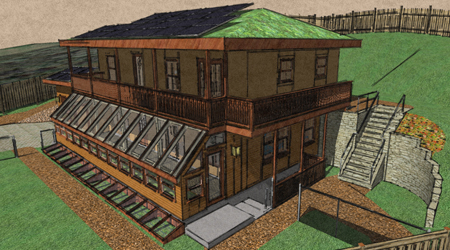
So yeah, we have yet to even buy the property and I’m already designing stage 2 but in my defense that is only because we don’t think we’ll have the money to do this all in 1 stage but this is what we want it to look like. Here are the latest series of photos of how the sun will hit it starting with the winter solstice at 8am, noon, and 5pm then moving on to the summer solstice and finally where it will land during the the equinoxes.

Share
Posted in alternative building techniques, architecture, cob, Community

Cob House Progress

It’s been a few weeks since I checked in and I wanted to give a status update as well as showing off some new renderings. First things first – let’s look at the latest illustrations starting with some interiors from the loft looking south at the rest of the house. Then we’ll move down the steps looking back north before we look up from the first floor at the cupola. Finally we’ll move outside and look at the winter solstice, summer solstice and the equinox at 8am, noon, and 5pm each.

Why are looking at 8am, noon, and 5pm on the solstices and the equinox? To get an idea of how the sun will fall on the house through the year so we can take advantage of passive solar techniques. The house you see on the right in the exteriors is falling apart and we hope that some other folks that want to build cob will buy the property and build there or that one day we can buy it and either do a size garden or workshop space. Who knows maybe Dave English and I will build a for-real lodge style cob & or straw-bale Schmutz Lodge to host events and community gatherings in there. You can also see some shadows cast onto our purposed building by the home on the left but the building itself is not in the photos.

Passive Solar Technology & Cob Building

To take advantage of passive solar technology your best bet is to build on a south facing slope. Our purposed building site is solar-south facing and will feature a large wall of windows that will allow the winter sun to enter the home and help to heat the house. As the sun moves across the sky in the summer large eves from the roof will keep it out of the windows like a hat brim keeps the sun out of your eyes. Not shown in the picture is what the outside landscaping will look like short of our hanging garden that we hope to erect using ladders like they have inside of construction junction or the eventual covered parking area that we will build next to the house.

Passive Solar is Important

Aside from reducing energy costs the Architectural Department at the University of Arizona helped another cob builder receive a permit for her home by providing information used to approve rammed earth homes in AZ by substituting actual R-value for equivalent R-value. Equivalent R-value is calculated by accounting for the high thermal mass that is common in a cob building. In Arizona they were able to show that a rammed earth home with an actual R-value of on R-11 has an equivalent R-value of R19 when passive solar techniques are employed. I’ve not studied rammed earth construction but I am fairly certain that they do not use straw in the rammed earth. If this is so cob has a higher R-value to begin with meaning that it is easier to reach an equivalent R-value in the range of R-25 which is what we should have in places like Pittsburgh.

Progress & Information Gathering

We are waiting on a few more bits of information that we can add to our information packet for the Bureau of Building Inspection, Zoning, URA, and the non-government groups we are sharing the packet with but we did hear back from BBI and they are receptive to the idea and willing to look over the packet and a zoning official says he just needs to see survey information and information on where the cob will be applied. Now if dealing with the URA goes this smoothly I’ll know we’re really onto something!

Speaking of the URA I started to ask around on City-Data and aside from one person missing the point of my question and simply posting a link to the properties I found out some useful information. First – that nobody on there had bought a URA owned property before but that at least one of them had bought city-owned and they did so often but had never attempted to deal with the URA (their reputation is clearly well known).

We’ve made a lot of progress on our budgeting and we’re around $20k right now with a number of things to add. The sewer line is our biggest worry. If the sewer and water authority make us replace the sewer to the main we are likely in some trouble financially.

When we finish the information packet for the city we’ll post it – that should be done tomorrow or Thursday. Until then enjoy the latest renderings!

Share
Posted in alternative building techniques, architecture, building design, cob

Cob House Number Crunching

integrated cob seating ideaThis will be the first in an ongoing series of posts about the cost and material volume of our planned cob house. As our plans are fluid you might find a lot that these numbers don’t match up down but we’ll explain what they mean each time so that should help anyone who is using the info we are putting together for their own project or to try to figure out how to do a similar project.

Right now the ideas center around a mostly round structure with a reciprocal roof sitting on two city lots near the crest of a south-facing hill. The picture on the left shows some of the design idea which is two floor, open, and will feature passive solar designs.

Architects & Structural Engineers & Inspectors! OH MY!

First things first – let’s talk about people that we’re sure to encounter (since we’re building in the city). We have yet to hire an architect or structural engineer which is almost certainly going to have to happen. For those that are unfamiliar with what an architect will do or those that think all they do is draw pictures of houses or building you should know they also  provide  a list of materials and estimated costs of those materials (if they don’t you should probably not be paying them what you’re paying them) in addition to reviewing and/or reworking your plans. Architects are (usually) really cool people and you should not look at them (or at engineers or inspectors) as evil people that you need to pay a toll to. They should be viewed as collaborators – find someone you like, respect, and want to work with. We’re looking for just that right now.

Structural engineers are people who love to test stuff and look at data. Don’t think of them as a hurdle – think of them as not only making sure what you’re doing is safe but as providing you with solid information that will inform your process. Again – find someone who you like and that is fun to work with. An engaged structural engineer should be excited to test your materials, not standoffish, and they should be interested in the process you’re undertaking. We’re looking forward to finding such people.

You can’t choose your inspectors (well you can by choosing where you build) but for us – since we really really want to stay in Pittsburgh and to build here we kind of can’t. Though we can make sure they are at least comfortable with what we plan to do and we can build consensus and excitement in the community (which we are doing). This way even if the inspectors are not hot on the idea we will have a large support group that we can turn to in order to help influence their final decisions.

Cob by Numbers

So we have begun to think that including pumice is the way to go. Pittsburgh is not known for it’s wealth of volcanic material so we sadly will need to look outside of the area to find pumice and will have to pay for it’s transportation but it will make the walls stronger, lighter, and provide a higher R value as the pumice is more insulating. Since we’ve yet to order any materials we don’t know what the final mix will be but we aim to start with 30% clay, 30% pumice, and 40% sand Then we’ll test different amounts of straw to find a good mix of compressive strength and tensile strength. The straw decreases compressive strength but adds tensile strength.

We estimate that we will need approx 120 cubic yards of material for the external walls not including the urbaite that we plan to build the stem walls out of. Urbanite is recycled unreinforced concrete. Click on the link for more info.

What does 120 cubic yards look like?

An American football field is 100 yards plus 10 yards for each goal area – totaling 120 yards (flat). Set two fields next to each other (include sideline room) and stack 3 feet of material on top of them or stack 6 feet a material on top of one of them plus their sidelines and you’ve got the amount of raw material we’re going to need to use to build the exterior walls of our home.

Estimated costs of Sand & Pumice

We assume we’ll buy that much sand and pumice and dig up that much clay even though we’ll be adding significant volumes of straw to the mix since we’ll also be building interior walls out of cob. Sand costs anywhere from $25 to $40 a ton. With 120 cubic yards as our estimated starting figure and 30% of that being sand we’ll calculate that out to about 64.8 tons of sand which should cost between $1,500 and $2,600. Pumice is lighter so the tonnage should be less but we have not done the conversion or found prices yet. Even if it is equal to or slightly greater – 70% of our (non-straw) cost should not exceed $6000.

Estimated Cost of Clay & Straw

Since the clay will be harvested onsite (with the help of a small front loader) or if need be can be bought at a cost of less than $12 per ton. We plan to harvest a lot of the clay, if not all, onsite but needing as much as or more than 36 cubic yards could result in needing to buy some. A 36 cubic yard hole that is 6 feet deep must be 54 feet by 54 feet long. If it’s 9 feet deep we would need to dig a hole that is 27 feet wide by 54 feet long. 9 feet deep is deep. That’s the deep end of a swimming pool.

The good news is that clay is significantly denser than sand the tonnage should be much less though we have yet to do an accurate conversion or find a supplier to know the cost. Assuming the 36 cubic yards of clay is moderately dry there should be 8 1/3rd cubic yards per ton so we’d need less than 5 tons. Even paying $30/ton and buying the full supply that is only $150. I’ve seen bulk clay sold for less than $12 per ton but not  in the US. It is literally dirt cheap so finding someone who sells it is difficult (since the prices are so low).

Straw is cheap too – it’s a waste product of farming. Straw (not to be confused with hay) has zero nutritional value and is similar in organic makeup to wood. It costs anywhere from $0 to $10 or even $15 per bale. We won’t know how many bales we’ll need until we test our mix but assuming 300 bales at $5 each – that’s $1,500

This brings our total estimated material cost (not including roofing) to $7,650. We plan to buy the land from the city and we hope that it will not cost more than $5,000. All told that will bring the cost to somewhere under $15,000. We plan to buy used windows, doors, and as many fixtures and things as possible. Our goal is to spend less than another $10,000 on those items and the installation of electric, gas, and water. All told (if we add a cistern and some other materials) we should be  able to build the house for under $30k and hope to control costs and bring the total closer to $18,000 but that might be difficult. With both floors we plan to have approx 1,600 square feet of space. That would means our cost should fall between $11.25 and 18.75 per square foot. Even on the high end that is less than a 1/4 of the cost of a conventional home build in the US in 2011.

If you’d like more information or are interested in helping drop me a line on the contact form or leave a comment. We’re dedicated to helping anyone in the Pittsburgh area to build their own home this way that helps us to build ours!


Share
Posted in alternative building techniques, architecture, building design, cob, data, design, Efficiency

Pittsburgh Cob Home Building Update

Cob Home Design


So the wife and I found the land we want to build on inside of the city of Pittsburgh and we’ve got an email into BBI asking what information they will need to give us a building permit and ultimately an occupancy permit. We’ve also got an email into the local community group. As the land is city owned (actually URA owned) we need their approval for our project. I know some people might find that to be a huge pain but I actually really like that – maybe it has something to do with the fact that I am a VP on the board of directors of a similar community group.

Learning to build cob

While we are waiting to hear back from BBI and to have our meeting with the community group we are not sitting on our hands. We’ve been reaching out to others in and around Pittsburgh who may have some interest in what we are doing as well as talking to people around the country who have already built cob houses to find out how they got their buildings to pass inspection or what tested they had to have conducted for a structural engineer or architect to sign off of the building.

Compressive Strength vs. Tensile Strength

One thing we found is that the straw that is required for tensile strength brings down the compressive strength so we’ve looked into different types of pozzolans (additives) and while fly ash is abundant and free in Western PA we are worried about it’s toxicity. The soil we are going to be using will already probably contain some amount of lead so we want to use the cleanest stuff available.

It seems like pumice is probably our best bet. While pumice is not going to be able to be locally sourced it will not only make the cob stronger but will also make it lighter allowing us to build faster. It also adds insulation (or R) value. It will increase our cost for the cob but will lower the cost on the plaster side as we won’t need a full 4 inches of plaster to increase the R value as much.

If you are interested in learning more or in helping us when the project gets underway use the contact form or leave a comment and thank you for your interest!

Share
Posted in alternative building techniques, architecture, cob, Community, design, Government, Pittsburgh

Designing a Low Cost Home Redux

So if you read my post about cob building I said that we are thinking about building a cob place to stay in for a few years well … it’s funny how things change so fast!

The more than we’ve researched the more information we’re finding out about cob that tells us that a cob home is not only the way to go for a few years but is in fact the way to go for good. One of the concerns is that concrete (which we’d need for our underground home) is made of Portland Cement. Portland Cement releases 1.5 tons of carbon for each ton of cement produced. That’s not cool.

While we plan to have modern electricity, gas (for cooking and to add some mechanical heating), we can’t bring ourselves to a point where we are OK with releasing that much carbon when half the reason we want to live underground is because we want to help the environment!

So we’ve found a bit of land in the city and we’ve researched how to buy it. Our next step is to talk with the local community group about getting their help with buying the land and we need to double check that we are up on our taxes and make sure that Pittsburgh’s Bureau of Building Inspection will sign off on us using cob. After that we’ll buy the land and start to do this:

If you’re interested in helping build our home we are interested in doing an exchange – we’ll help you build yours if you help us build ours! Contact me via the website to discuss.

Why build with cob?

Why do we want to build a permanent cob home? We believe (we’ll find out) that we can build a home out of cob that is roughly 1,600 sq feet for under 20k (including the cost of the land). This means we could do so without needing a mortgage. If we can do it so can you and so can the other folks in the community we are looking to build in. This will free us from the grip of the industrial builders and all the other things that come along with them (mainly mortgage costs but also high energy costs, the cost of repairs, the risk of fire and need for fire insurance, health costs associated with volatile chemicals inside of industrial products like treated lumber, as well as environmental costs).

Cob is build with the onsite ground (which is what makes it less expensive) so we’ll also want to do some soil testing but as long as it checks out we should be in our cob home within 3 years!!!

Share
Posted in architecture, cob, Community, green living, Pittsburgh

Retractable Steps – Residential Design

Natural Building

So as many of you know Teresa (the wife) and I are looking to build a cob home and to reduce our ecological impact on the earth. One of the great things about building your own home is that you get to choose how big or small it is (sorta). There are constraints like labor and material costs and availability and with those in mind we have decided to start with an idea of a roughly 30′ round foundation with a lofted 2nd floor that would house a bedroom, second bath, washer and dryer, closet space and office space.

Space Saving Step Design

In order to have enough room for the loft that we want and to accommodate all of the downstairs items that we’ll have (as well as to have parties and just because I like to make cool stuff) I decided that having retracting stairs to the second floor might be the way to go. I started off thinking that I’d want them to collapse into a usable ladder shape and the idea I have does do that but the retracting steps don’t function like those attic steps (really ladders) that were popularly added to stick frame (mostly ranch style) homes in the 70s and 80s.

What I wanted to create is something new and never before seen so below is a gallery of what I came up with:

These steps would roll closed (though the axle needs to roll to close fully) and they should be light enough that anyone can operate them. There will be pins to lock them in place both to lock the axles and (not shown above) to lock the steps in place. These pins will be attached to their support structure with rope or small chain so they are not lost. The most likely material that they would be built of would be metal but a strong and light wood could be used too.


Share
Posted in architecture, building design, designs for compact living, furniture design

Cob Building Missed-Adventures

First let me explain the title of the post. If you’re a regular reader you know that my wife Teresa and I are interested in building a cob house but don’t have any experience (yet). So over the weekend Teresa found a local group on MeetUp.com that was holding a cob building workshop today. We both tried to register but we needed to be admitted to the group first – something that has still not happened.

No worries – I’ve never been one to shy away from crashing an event that could benefit from my attendance so after checking yesterday to make sure it was still on – off I went in the 94 degree heat on my bicycle to learn how to make cob in the unforgiving summer sun.

Or not.

See when I got there 2 minutes late (is that fashionably late or still on time? I have a hard time knowing) I was alone. I was not even joined by crickets. Just me, the blistering summer sun, and an urban garden with some dudes in the alley behind said garden tossing horseshoes. I did think about asking the horseshoe fellas if they were there to learn about building things out of cob but they didn’t seem the type so I rode right past them heading for home.

On my way home I stopped in Espresso a Mano which is great little coffee shop in Lawrenceville about half-way between where I live and where I found disappointment in the face of Cob I checked the meetup group again and saw the event had been marked cancelled. Bummer. I wish they’d have cancelled earlier – like a few days ago maybe but I can’t get too upset since they didn’t know I was coming.

While I was really looking forward to the workshop the fact that it was cancelled has given rise to the idea that the Schmutz Company could maybe host a cob building workshop. I plan on running this past Dave to see what he thinks of the idea but seeing as how he was talking about building an oven for baking bread and pizzas and things I don’t know that I’ll need to twist his arm too much. If you’d be interested in attending leave a comment below or email me from the contact page and I’ll be sure to let you know what the plan is. Oh, and if we schedule and then cancel it we’ll let you know several days in advance.

For some great photos of what cob and other natural building materials look like check out the Natural Building Flickr group or just do a Google image search for cob – there are a ton of pictures of amazing things that are and can be built out of the stuff!

Share
Posted in alternative building techniques, architecture, building design, cob, Community, design, Education, green living, Pittsburgh

Designing a Low Cost Home

So if you read this blog regularly you probably saw the post the other day about the underground home that I designed for us based off of the popular models that I’ve seen on the website of many different builders that specialize in said buildings. Since my wife and I have been talking more and more about the idea we’ve talked a lot about the amount of money that we’ll need to build it. We want to make sure that we have enough money to build at least a 3 bedroom home. A 3 bedroom home will provide enough room in the event that we ever have kids and will make it easier to sell if we ever were to do so.

It seems like we are going to need more money than what we expect to be able to save up over the next few years so we’re thinking of alternative ways to save money.

Cob Building

What we’re thinking of doing is buying the land that we want and building a cob building. I’ve got to eat my own words because I’ve told people that I wouldn’t do such a thing as they are not a good choice for the Pittsburgh area.

Cob buildings are not a great choice for the Pittsburgh area because of humidity and yearly rainfall but we think we can build one to live in for a few years while we save up to build our underground house. Cob buildings are made of earth – clay, sand, straw, and so on. They can be built fairly cheap ($5k to $10k) though ours would likely cost a bit more since want to have electric and plumbing. We’re now thinking of building an approx 1,000 sq foot one bedroom 1 bath cob structure.

For more info on building cob buildings and for examples check these out:


Share
Posted in architecture, building design

Secrets to Web Design Sucess

This is one in a series of posts that will offer little bits of advise for making sure your website is user friendly for both your visitors and you back-end user. 

Keeping your site in order

It’s important to keep the data on your website organized. One thing that can help is a content management system. Content Management Systems (CMS) will not only provide you with a means of editing your website with little or no knowledge of things like HTML, CSS, or other coding languages. CMS’s keep your website organized by being database driven and they often offer many different ways to organize your data. They can help you keep things organized inside of categories or through tagging (often used for blogs) or even by the simple act of keeping information listed on your website in data order.

Customizing your website order

Even with all of the built in ways that your CMS allows you to keep your data organized you might still need want to be able to customize the order in which items on your website are seen. If your CMS doesn’t give you the option to manually re-order your information you might want to look for add-ons or widgets that will allow you to do so.

We recently launched a real estate website for a client where they not only needed to organize property listings by categories (how many bedrooms, location, or property type) but also to organize those listings within the categories in order to move different listings up or down to try to move certain properties faster. We built the site in WordPress and we happily found a widget that allowed the realty company employees to drag-and-drop the listings in order to reorder them.

While they are able to rearrange their listings it’s important to remember that WordPress – their CMS is still keeping their data organized in a database so it can easily be searched for, located, and worked on.

If you’re website is less than organized contact us and we can discuss how to get your site clean and organized.

Share
Posted in web design